Wednesday, January 13, 2010

Getting acne....Q&A............(part 3 of 5)


I’ve started getting acne spots. How long do they last?

This depends on what type of spots they are and, even then, it can
be very difficult to predict what will happen. Some spots will
appear and then disappear during the course of a day but others
will evolve more gradually through the various stages. Comedones
can be very persistent if they don’t get inflamed. Mildly inflamed
spots will last 5–10 days before settling down, but can leave a flat
red mark (macule) for several weeks. Nodules and cysts may last
for weeks or months unless you get some treatment.

What is the difference between a whitehead and a yellow-
head spot?

These two common terms describe quite different types of spot.
A whitehead is a closed comedone where the pore is blocked and
not open to the air. There is no inflammation (redness). A yellow-
head suggests a spot with pus in it. The medical term is a ‘pustule’.
Whiteheads may become yellowheads if the blocked pore becomes
infected.

My daughter is only 9 but she seems to have developed some
blackheads around her nose. Can this be acne – like I had?

Girls seem to be starting puberty earlier and earlier, and many
9-year-olds have started to develop some hormone changes.
Blackheads are one of the types of spots that occur in acne so,
yes, this could well be the start of it. Almost all children will get
some blackheads and other spots as they start and go through
puberty, so your daughter will not necessarily get worse but this
might depend on how bad your own acne was. We don’t fully
understand the role of genes in acne but there is some inherited
factor that makes acne more likely in some families. If you had
severe acne, it is worth starting a simple treatment approach to
reduce the number of blackheads on your daughter’s nose.

I am an identical twin and I have acne but my sister
doesn’t – weird or what? Can you explain why?

Answering questions like this is always difficult. We can’t give you a
reason why your twin doesn’t have acne, because the precise cause
and triggers are not fully understood. However, studies of twins
have helped to work out that some genetic inheritance is involved,
as identical twins tend to produce similar amounts of the skin
grease called sebum. This is not the case for non-identical twins.
You don’t say how old you are – it may be that your sister will
go on to develop acne. She is certainly more likely to have acne
than if she were not your twin.

I have been having problems with my skin for about two years. Can you tell me what the difference is between spots and acne? I think that to have acne you must have at least 20 spots but my mum thinks otherwise.

There is no real difference between spots and acne, assuming
that the type of spots fits into the pattern we have described with
blackheads, whiteheads, papules and pustules. What is most
important is the effect the spots have on you and whether you
have any of the more serious types of spot that might cause long-
term scars. If you are upset by the appearance of your skin, it
doesn’t really matter how many spots you have – you have a
problem that is worth seeking some treatment for.

Why am I the only one in my class who has spots? I heard
it was very common but I don’t think it is really.

The most important spots are the ones that you have, and you
will be much more aware of them than anyone else. Other
students might have spots that you can’t see – on their back or
chest – or they might be using some treatment or camouflaging
make-up. Don’t worry about them; just talk to your pharmacist or
doctor if you are not already using some creams.

Wednesday, June 24, 2009

What is acne?.....................(part 2 of 5 )

Below we outline the types of spots you can get, so you can tell whether you have a mild, moderate or severe problem. They do not all have to be present for you to have acne. Just one type will still mean you have this condition, and there are effective treatments no matter how bad your problem is.

Comedones

These are the starting point of all acne. They begin as very small blockages in the pores. At this stage a blockage is referred to as a microcomedone – the comedone is too small to be seen. Microcomedones can progress to become larger comedones, or they can burst (rupture) internally, causing different types of spots.They burst because of the build-up of pressure and the damage that the inflammatory process does to the wall of the duct.

Whiteheads (closed comedones)

Some people think of whiteheads as a type of pus-like spots, but they are not. As the microcomedone gets larger, because swelling is building up behind the blockage, it becomes visible. If the initial blockage is quite deep in the pore, the opening onto the skin will remain closed; this causes the typical whitish lump that can be seen and felt on the surface.
Blackheads (open comedones)

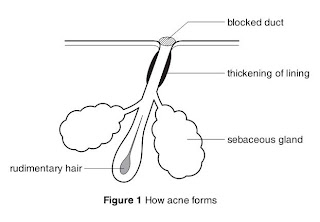
These are clearly visible and very annoying because they look so dark and obvious. The blockage has occurred further up the duct, so its opening is widened and the contents are visible. If you were to dissect your skin, you would see the curly sebaceous gland –which is the escape route for oil – blocked full of a hard, yellow plug. This plug is a mixture of the sebum that has solidified and
the dead lining cells that have been shed. Because these are like skin cells, they contain some of the pigment (melanin) that gives skin its colour. This pigment turns dark when it is exposed to air,so the ‘black’ in ‘blackhead’ is notdirt.

Inflamed spots

Comedones can stay quite happily in your skin for months, or even years, without changing. If they progress or burst (rupture), though, different kinds of spots result: papules, pustules, nodules and cysts.

Papules

If the comedones start to leak sebum into the surrounding tissue, this produces inflammation and a red spot results. Papules are less than 5mm across and have no pus visible. They could be
called ‘redheads’, as they are otherwise like the whiteheads. If your microcomedones rupture, you will produce papules without going through the whitehead and blackhead stage.

Pustules

A pustule is the typical pus spot or yellowhead. These occur when the bacteria present on the skin and in the duct start to multiply. These bacteria are called Propionibacterium acnes
(usually shortened to P. acnes). They prefer dark places with no air to breed. A blocked pore is ideal and soon there will be lots of bacteria producing more inflammation; this triggers the body’s
own defences as mentioned above, leading to a head of pus on a red swelling.

Nodules and cysts

Comedones, papules and pustules are nasty to look at and caus pain associated with the swelling and inflammation but will clea up without causing much scarring except in people wit
pigmented skin. (This is discussed further in Chapter 6, The physical scars.) The next two types of spot mentioned, howeve – nodules and cysts – can cause real and lasting damage.

Nodules

Nodules are solid spots; they are much bigger than papules and extend deeper into the skin. They are caused when a large comedone has ruptured, releasing lots of inflammatory contents
(white cells and bacteria) into the surrounding skin. More inflammation and pus result, leading to more pain and swelling.The nodule extends deeper into the area that contains the skin’s
structural support. Damage here leads to the scarring.

Cysts

Unlike nodules, cysts are bags of liquid that is a mixture of pus and bacteria. Cysts usually occur only with nodules, often when two or three are close together. They are even more destructive
than nodules to the structure of the skin but, luckily, are quite rare.

Saturday, June 20, 2009

What is acne? ......................(part 1 of 5)


‘Acne is just when you get a load of spots all over your face. You
probably need to have about 20 for it to be bad.’
‘I think it is when you don’t wash and your face gets all spotty
and horrible.’
Acne is, in fact, the world’s most common skin disease. You know you have it when your skin develops blackheads, whiteheads, or red or yellow spots and becomes greasy. These are the classic signs and it doesn’t matter how many you have for your doctor to confirm it as acne. Acne doesn’t care who you are, what colour your skin is or how old you are. However, it is far more
likely that, as you approach puberty, your skin will start to change enough to kick-start the ‘acne process’. What most people don’t know is that you don’t always grow out of it: 15 per cent of
women in their 40s are still troubled by acne, although for men is it less likely to carry on for so long.

It’s a cruel fact that acne feels most at home on your face, butt can also crop up on your neck, back, chest or shoulders. This is because the oil-producing glands (the sebaceous glands) on your
skin are most concentrated here.

There has been extensive research into acne, and dermatologists blame four main factors in the skin:
  • Firstly, the body seems to become extremely sensitive to the male hormones (the androgens) in the body. Women as well as men have male hormones but, because men have higher levels, they are often more affected. However, there do not have to be large amounts of these male hormones to get the oil-producing glands over-working, which makes them pump out more oil – called sebum.
  • Secondly, these oil-producing glands have an opening into pores in the skin – small holes at the top of a tube or duct. At the bottom of the duct lies a hair follicle – specialised cells that are capable of producing a hair. The gland opens about half-way up the duct, which is lined by cells just like the ones on the surface of the skin. If you are affected by acne, these cells tend to clump together when they die and are shed, and cause the duct to narrow.
  • Thirdly, the combination of this narrowing and the excess sebum results in the blockage – the starting point for all types of acne. This creates a wonderful environment for the acne bacteria that normally live on the skin: they start to multiply, which can lead to infection and inflammation.
  • Fourthly, this inflammation then wakes up the body’s defence system, which sends white blood cells to fight the bacteria and repair the damage caused. These white blood
    cells make up the bulk of what we see as pus – yellow or greenish fluid produced by the body in response to inflammation; it contains lots of white cells that come out of the blood stream to attack the cause of the inflammation. But, if the blockage doesn’t become infected, it will remain as a solid plug – or what we know as a blackhead.

Enhancing retinoid treatment for acne


Removal of comedones can also help to treat your acne and speed up improvement. Your dermatologist may perform acne surgery with a comedo extractor, a small instrument that mechanically removes comedones. Comedo removal can be a useful adjunct to topical therapy when your blackheads and whiteheads are somewhat resistant to topical retinoids.

Acne surgery is a noninvasive surgery, meaning that the blackheads and whiteheads are simply popped or squeezed out with the extracor. The extractoris a special instrument that minimizes skin injury.A round loop extractor is used to apply uniform smooth pressure to dislodge the material. Lesions that offer resistance are loosened by nserting a pointed instrument to carefully expose the contents.

Pretreatment with a topical retinoid for four to six weeks often facilitates the procedure because it helps open up your pores.Comedo extraction is performed less commonly nowadays since
the arrival of topical retinoids.

Comedo extraction is often performed successfully by aestheticians as part of a facial. An experienced technician may remove your blackheads and whiteheads with tissue paper or with another instrument.

WARNING
An improperly trained technician may also try to squeeze out your red papules which can result in persistent redness and even scarring.

Friday, June 19, 2009

Dealing with side effects of retinoids


All retinoids can cause some skin irritation during the first few weeks of use. You may have some discomfort, such as stinging or burning, and sometimes may experience mild redness and scaling of your skin. These reactions are to be expected, and they’re an indication that the retinoid is working. After several weeks, your skin generally gets used to the medication and the discomfort eases.

A common belief is that retinoids dry the skin. But they’re actually sloughing off dead skin cells.

If you have a sensitivity to the retinoid you were prescribed, you can take a number of steps to help ease the irritation:

  • Build up a tolerance: Start off by using the retinoid every other day, or even less frequently, until you get used to it.If you have extremely sensitive skin, try applying the retinoid for short periods of time, such as leaving it on for a few minutes and then washing it off. You can put it on for as little as two to five minutes. This tends to make it more tolerable and the medicine still has positive effects as long as you stick with it. As your skin becomes accustomed to the retinoid, you can gradually increase the frequency of application and how long you leave it on. Eventually you may be able to apply it every day and leave it on all day or overnight.
  • Avoid irritating OTC products: Make sure that you’re not also using an over-the-counter product that contains salicylic acid,retinols, or other possible irritants.
  • Ask your doctor to prescribe a cream or a weaker concentration of the medicine. Creams are the least irritating delivery vehicle. The concentration of the agent affects the degree
    of irritation.
  • morning. (If you also use a sunscreen, apply it over the mois-Use a moisturizer: If you get dry and scaly, apply a moisturizer generously in the morning. The moisturizer should be applied over any medication you apply at night or in the morning. (If you also use a sunscreen, apply it over the moisturizer.) Effective moisturizers include Oil of Olay, Nivea Ultra Moisturizing Creme, and Eucerin creams. Use only emollient,non-irritating cleansers to wash your face when you’re using a topical retinoid.
warning Retinoids may produce sun sensitivity. A common misconception is that tretinoin shouldn’t be used during the summertime, during sunny weather, or in tropical climates. Retinoids can make you somewhat more susceptible to sunburn, however, this problem eases after the drug has been used for a month or two. Retinoids can be applied at any time of year in any geographic region.

If you’re using a retinoid in sunny conditions, particularly if you have fair skin, just take simple sun-protective measures, such as avoiding the midday sun, applying a broad-spectrum sunscreen or sunblock (over the medication), and wearing a protective cap or hat. Applying them at bedtime is added insurance against your having problems with sun exposure the next day.